
RESOURCES & INSIGHTS
Knowledge Center
Explore practical insights, operational strategies, leadership guidance, and industry resources created exclusively for plaintiff personal injury law firms.
Whether your firm is improving workflows, strengthening its team, or preparing for growth, the ULSS Knowledge Center provides practical information designed to help your operation become more efficient, consistent, and scalable.

5 Ways to Improve Plaintiff PI Intake Efficiency
5 Ways to Improve Plaintiff PI Intake Efficiency
Category: Client Experience
Reading Time: 5 Minutes
Author: United Legal Support Services
Every Great Case Begins with an Exceptional Intake Process
The client intake process is one of the most important stages of any plaintiff personal injury case. It is the first opportunity to build trust, gather critical information, and establish the operational foundation that will support the case through settlement or litigation.
Yet for many law firms, intake can become a bottleneck. Missed details, inconsistent documentation, delayed follow-up, and inefficient workflows often create unnecessary challenges that affect both client satisfaction and case progression.
By implementing a structured intake process, law firms can improve efficiency, strengthen client relationships, and create a more organized operation from day one.
Here are five practical strategies every plaintiff personal injury law firm can implement.
1. Standardize Your Intake Process
Consistency is one of the most effective ways to improve efficiency.
Every prospective client should move through the same structured intake workflow regardless of who answers the phone or conducts the consultation.
A standardized process helps ensure that important information is never overlooked while creating a consistent experience for every client.
Best Practices
Create a standardized intake checklist.
Use consistent intake questionnaires.
Verify all contact information before ending the call.
Collect accident details, insurance information, and treatment status.
Establish clear next steps before concluding the intake.
A documented process also makes training new team members significantly easier.
2. Respond Quickly to New Inquiries
Speed matters.
Many prospective clients contact multiple law firms before making a hiring decision. Firms that respond promptly demonstrate professionalism, organization, and genuine concern for the client's situation.
Even if a full consultation cannot occur immediately, acknowledging the inquiry and communicating next steps builds confidence.
Best Practices
Return calls as quickly as possible.
Respond promptly to website inquiries.
Send confirmation emails or text messages.
Schedule consultations without unnecessary delays.
Establish response-time goals for your team.
The first impression often determines whether a prospective client chooses your firm.
3. Collect Complete Information During the Initial Contact
Incomplete information often leads to repeated follow-up calls, delayed case setup, and additional administrative work.
Gathering comprehensive information during the first conversation allows the legal team to begin working efficiently.
Information to Collect
Accident details
Date and location of the incident
Insurance carrier information
Medical treatment status
Employer information (when applicable)
Witness information
Photographs or available documentation
Existing legal representation
The more complete the intake, the smoother the transition into active case management.
4. Maintain Consistent Communication
Clients feel more confident when they understand what happens next.
Even simple updates help reduce uncertainty and improve the overall client experience.
Clear communication also decreases unnecessary inbound calls asking for status updates.
Best Practices
Explain the next steps before ending the intake.
Set realistic expectations.
Provide estimated timelines.
Introduce the primary point of contact.
Confirm receipt of important documents.
Communication builds trust long before the first settlement discussion.
5. Continuously Evaluate Your Intake Process
Operational excellence requires continuous improvement.
Successful firms regularly evaluate their intake process to identify opportunities for greater efficiency and consistency.
Small improvements often produce significant long-term results.
Questions to Ask
Where do delays occur?
Are clients completing paperwork promptly?
Is information being collected consistently?
Are follow-up tasks completed on time?
Can technology or workflow improvements reduce administrative burdens?
Tracking performance allows firms to make informed operational decisions rather than relying on assumptions.
The Bottom Line
A strong intake process does more than collect information, it establishes the foundation for the entire client relationship.
When intake is organized, consistent, and client-focused, law firms can improve operational efficiency, strengthen communication, reduce administrative burdens, and create a better experience for every client they serve.
Investing in your intake process today creates stronger operations and better outcomes tomorrow.
About United Legal Support Services
United Legal Support Services (ULSS) partners exclusively with plaintiff personal injury law firms to provide attorney-supervised operational support. From client intake and insurance claims administration to medical records management, demand preparation, and operational consulting, our experienced professionals integrate seamlessly with your team to strengthen workflows and support long-term growth.
Ready to Strengthen Your Firm's Operations?
If your firm is looking to improve efficiency, streamline workflows, and build a stronger operational foundation, United Legal Support Services is here to help.
Contact us today to learn how our attorney-supervised operational support can help your firm serve clients more effectively and grow with confidence.

Building a Scalable Pre-Litigation Team
Building a Scalable Pre-Litigation Team
How Strong Operations Create Capacity for Sustainable Law Firm Growth
Category: Law Firm Operations
Reading Time: 6 Minutes
Author: United Legal Support Services
Growth Shouldn't Create Chaos
For many plaintiff personal injury law firms, growth is an exciting milestone. More signed cases, additional referrals, and increasing revenue are all signs of success. However, without a scalable pre-litigation team, that growth can quickly lead to overwhelmed staff, inconsistent client communication, delayed case progression, and operational bottlenecks.
Hiring more people alone doesn't solve these challenges. Sustainable growth requires intentional systems, clearly defined roles, standardized workflows, and a team that can operate efficiently as caseloads increase.
The firms that scale successfully aren't necessarily the ones with the largest teams—they're the ones with the strongest operational foundation.
What Is a Scalable Pre-Litigation Team?
A scalable pre-litigation team is designed to handle increasing case volume without sacrificing quality, communication, or efficiency.
Rather than relying on individual employees to "figure it out," scalable teams operate within structured systems that promote consistency and accountability.
Every team member understands their responsibilities, workflows are clearly documented, and cases continue moving forward regardless of fluctuations in workload.
1. Clearly Define Roles and Responsibilities
One of the biggest causes of operational inefficiency is role confusion.
When multiple employees assume someone else is responsible for a task—or when one employee is responsible for everything—important work can fall through the cracks.
Clearly defining responsibilities creates accountability while improving productivity.
Every pre-litigation department should clearly identify responsibility for:
Client Intake
Insurance Claims Administration
Medical Records & Billing
Treatment Monitoring
Investigation Support
Demand Preparation
Client Communication
Case Quality Control
When responsibilities are clearly assigned, teams spend less time determining ownership and more time moving cases forward.
2. Standardize Every Workflow
Consistency creates efficiency.
Without standardized workflows, every employee develops their own process, leading to inconsistent client experiences and unnecessary delays.
Documenting standard operating procedures (SOPs) ensures that every case progresses through the same proven process.
Workflows should include:
New Client Intake
Case Opening Procedures
Insurance Reporting
Medical Records Requests
Provider Follow-Up
Treatment Tracking
Demand Preparation
Settlement Coordination
Case Closing Procedures
Well-documented processes also make onboarding new employees significantly faster.
3. Invest in Communication
Strong communication is often what separates exceptional firms from average ones.
Clients want to feel informed, supported, and confident throughout the life of their case.
Internal communication is equally important. Teams that communicate effectively resolve issues faster, avoid duplicated work, and maintain momentum.
Best Practices
Schedule regular case reviews.
Establish internal communication standards.
Provide clients with proactive updates.
Document all significant case activity.
Maintain consistent follow-up schedules.
Good communication improves both operational efficiency and client satisfaction.
4. Build Systems Before You Need Them
One of the most common mistakes growing firms make is waiting until they are overwhelmed before improving operations.
Scalable firms prepare for growth by building systems before increased caseloads expose weaknesses.
Examples include:
Workflow automation where appropriate
Standardized document templates
Quality control checklists
Performance tracking
Capacity planning
Operational reporting
Strong systems allow teams to absorb additional work without sacrificing consistency.
5. Measure Performance
Operational excellence requires measurable results.
Tracking key performance indicators (KPIs) helps identify bottlenecks, monitor productivity, and support continuous improvement.
Metrics Worth Tracking
New client response time
Intake completion time
Medical records turnaround
Demand preparation timelines
Client communication frequency
Case progression milestones
Employee workload distribution
When firms rely on data instead of assumptions, they can make more informed operational decisions.
6. Think Beyond Staffing
Adding employees may temporarily reduce workload, but long-term scalability comes from strengthening operations—not simply increasing headcount.
Successful firms invest in experienced operational support, efficient workflows, and consistent processes that enable their attorneys to remain focused on practicing law.
A strategic operational partner can provide additional capacity while preserving consistency and reducing the administrative burden placed on internal staff.
The Bottom Line
A scalable pre-litigation team is built on more than talented people. It requires structure, accountability, communication, and operational discipline.
When law firms invest in strong workflows and experienced operational support, they create an environment where attorneys can focus on advocacy, staff can perform at their highest level, and clients receive the consistent service they deserve.
Growth doesn't have to create operational challenges. With the right foundation, it becomes an opportunity to serve more clients while maintaining the quality and professionalism that define your firm.
About United Legal Support Services
United Legal Support Services partners exclusively with plaintiff personal injury law firms to provide attorney-supervised operational support that strengthens pre-litigation operations nationwide. From client intake and medical records management to demand preparation, insurance claims administration, and operational consulting, our experienced professionals integrate seamlessly with your team to improve efficiency, enhance client service, and support sustainable growth.
Ready to Build a Stronger Operational Foundation?
Whether your firm is preparing for growth or looking to improve the efficiency of your current pre-litigation department, United Legal Support Services can help.
Contact us today to learn how our attorney-supervised operational support can strengthen your workflows, improve consistency, and position your firm for long-term success.
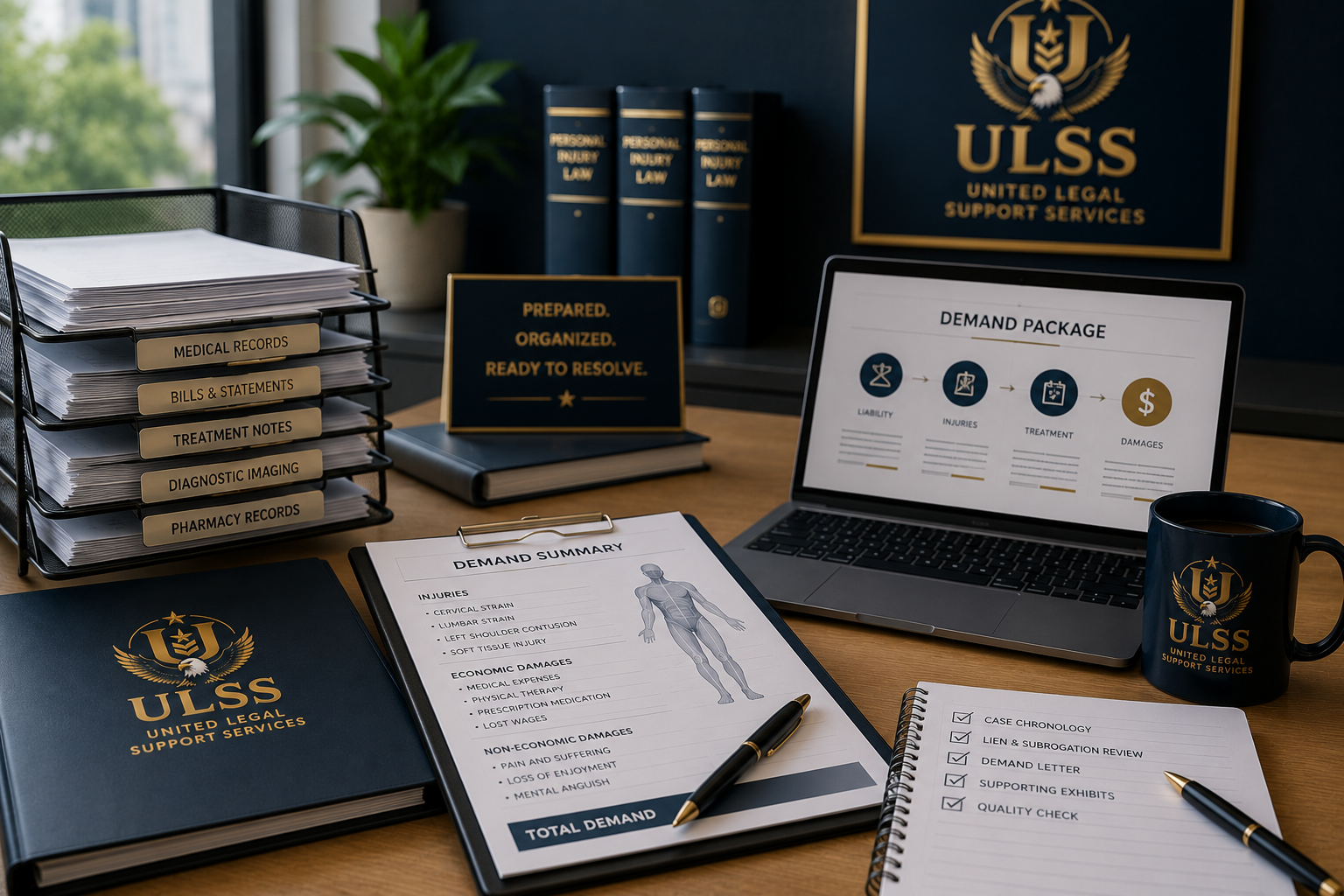
Demand Package Best Practices Every Firm Should Know
Demand Package Best Practices Every Plaintiff Personal Injury Law Firm Should Know
Building Organized, Persuasive, and Efficient Demand Packages That Support Better Case Outcomes
Category: Demand Preparation
Reading Time: 7 Minutes
Author: United Legal Support Services
A Well-Prepared Demand Package Tells the Client's Story
A demand package is more than a collection of medical records and bills—it's the opportunity to present a complete picture of how an injury has affected a client's life. A thoughtfully organized demand package helps insurance adjusters understand liability, medical treatment, damages, and the overall value of a claim.
When demand preparation lacks organization or consistency, important details can be overlooked, negotiations may be delayed, and attorneys often spend valuable time correcting avoidable issues.
A structured approach to demand preparation improves efficiency, strengthens case presentation, and allows attorneys to focus on legal strategy rather than administrative tasks.
1. Begin Preparing Long Before Treatment Ends
One of the most common mistakes is waiting until treatment concludes before organizing the file.
Successful firms begin building the demand package throughout the life of the case.
Medical records, billing statements, photographs, insurance correspondence, and investigative documents should be collected and organized as they become available.
Preparing continuously reduces last-minute scrambling and allows demand preparation to move forward quickly once treatment is complete.
Best Practices
Maintain organized digital case files.
Request records throughout treatment.
Track outstanding providers.
Verify medical billing balances regularly.
Update case summaries as new information is received.
Preparation should be an ongoing process—not a final task.
2. Organize Medical Records Chronologically
Medical records tell the story of recovery.
When records are presented chronologically, they allow the reviewer to understand the progression of treatment, the severity of injuries, and the client's healing process.
Disorganized records create confusion and make important information difficult to locate.
Include
Emergency treatment
EMS reports
Hospital records
Specialist records
Imaging reports
Physical therapy
Chiropractic care
Surgical records
Pain management
Final treatment notes
A chronological presentation creates clarity and credibility.
3. Verify Every Medical Bill
Accurate damages begin with accurate billing.
Before assembling a demand package, verify that every medical bill has been received and that balances are accurate.
Missing providers or duplicate billing can delay negotiations and create unnecessary follow-up.
Confirm
Provider names
Dates of service
Billing totals
Insurance payments
Outstanding balances
Liens or subrogation interests
Attention to detail during this stage prevents costly mistakes later.
4. Build a Clear Medical Summary
Insurance adjusters often review hundreds of claims.
A concise medical summary helps them quickly understand the client's injuries, treatment progression, and overall recovery.
Rather than forcing the reviewer to search through hundreds of pages of records, provide a structured overview that highlights the most important information.
Include
Mechanism of injury
Initial diagnosis
Treatment timeline
Major procedures
Ongoing complaints
Future treatment recommendations
Final prognosis
A well-written summary improves readability and strengthens the overall presentation.
5. Include Supporting Evidence
A strong demand package extends beyond medical documentation.
Supporting evidence provides additional context and reinforces liability and damages.
Supporting Documentation
Accident reports
Scene photographs
Vehicle damage photographs
Witness statements
Insurance declarations
Wage loss documentation
Property damage estimates
Correspondence
Expert opinions (when appropriate)
Every supporting document should reinforce the client's story.
6. Perform a Final Quality Control Review
Before a demand package is submitted, conduct a thorough quality review.
This final review helps identify missing documentation, formatting inconsistencies, or errors that could affect negotiations.
Final Checklist
✓ All medical records included
✓ All medical bills verified
✓ Supporting evidence attached
✓ Medical chronology completed
✓ Settlement demand reviewed
✓ Dates verified
✓ Names verified
✓ Attorney review completed
Consistency at this stage reflects professionalism and attention to detail.
7. Remember the Goal
The objective of every demand package is to present the client's case in a clear, organized, and persuasive manner.
An effective demand package should allow the reviewer to understand:
What happened
Why liability exists
The injuries sustained
The treatment received
The financial impact
The overall value of the claim
When information is organized logically and supported by complete documentation, attorneys are positioned to negotiate from a place of strength.
The Bottom Line
Demand preparation is one of the most important operational functions within a plaintiff personal injury practice.
Well-organized demand packages improve efficiency, reduce delays, strengthen negotiations, and demonstrate the professionalism of the firm representing the client.
By implementing standardized processes, maintaining organized documentation, and performing consistent quality reviews, law firms can create demand packages that support both operational excellence and better client outcomes.
About United Legal Support Services
United Legal Support Services partners exclusively with plaintiff personal injury law firms to provide attorney-supervised operational support nationwide. From client intake and medical records management to insurance claims administration, demand preparation, and operational consulting, our experienced professionals integrate seamlessly with your firm's existing workflows to improve efficiency, strengthen client service, and support sustainable growth.
Ready to Improve Your Demand Preparation Process?
Efficient demand preparation begins with strong operational systems.
If your firm is looking to streamline workflows, improve documentation, and build a more efficient pre-litigation operation, United Legal Support Services is ready to help.
Contact us today to learn how our attorney-supervised operational support can strengthen your firm's processes and position your team for long-term success.